
Video Annotation for Retail Surveillance: How Stores Teach Cameras to Actually Understand What They're Recording
Walk into any mall in Dallas, such as the Galleria on a Saturday afternoon, and you will notice that cameras are surveilling every aisle in the mall. All that information is captured but remains unanalyzed. The camera may capture an individual lingering by the shelves, and does not know whether he or she is comparing the prices of items in the store or is about to commit theft. That is why annotating videos is so important in retail security.
Sept 15 2026
Vedio Annotation
Key Takeaways
- It involves tagging the surveillance camera video so that the model can distinguish between legitimate browsing and shoplifting.
- Common scenarios include theft prevention, customer tracking, queue management, and shelf management.
- Multi-angle tracking involves accurately identifying the same individual at varying overlapping angles.
- Human intervention will also help identify actions that automated systems fail to detect, particularly theft.
- An adequately labeled dataset is more important than having lots of untagged data.
What a Store Camera Records vs. What It Needs to Understand
All that a CCTV camera does is frame by frame capture. It knows nothing about the true meaning of “loitering around the electronics section” or why it is more significant to put something in a bag in some circumstances rather than others. Annotating is the process of teaching the model this difference.
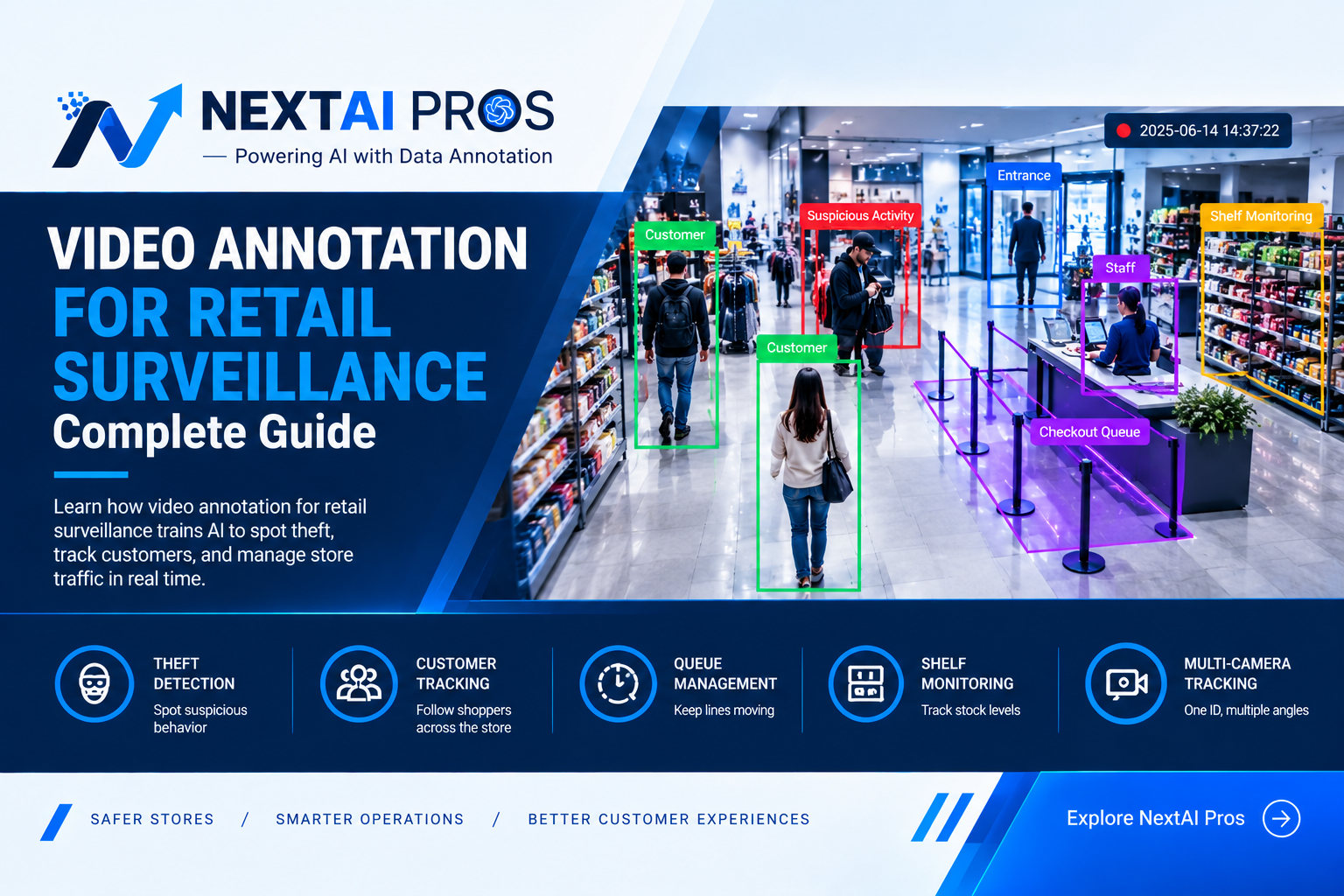
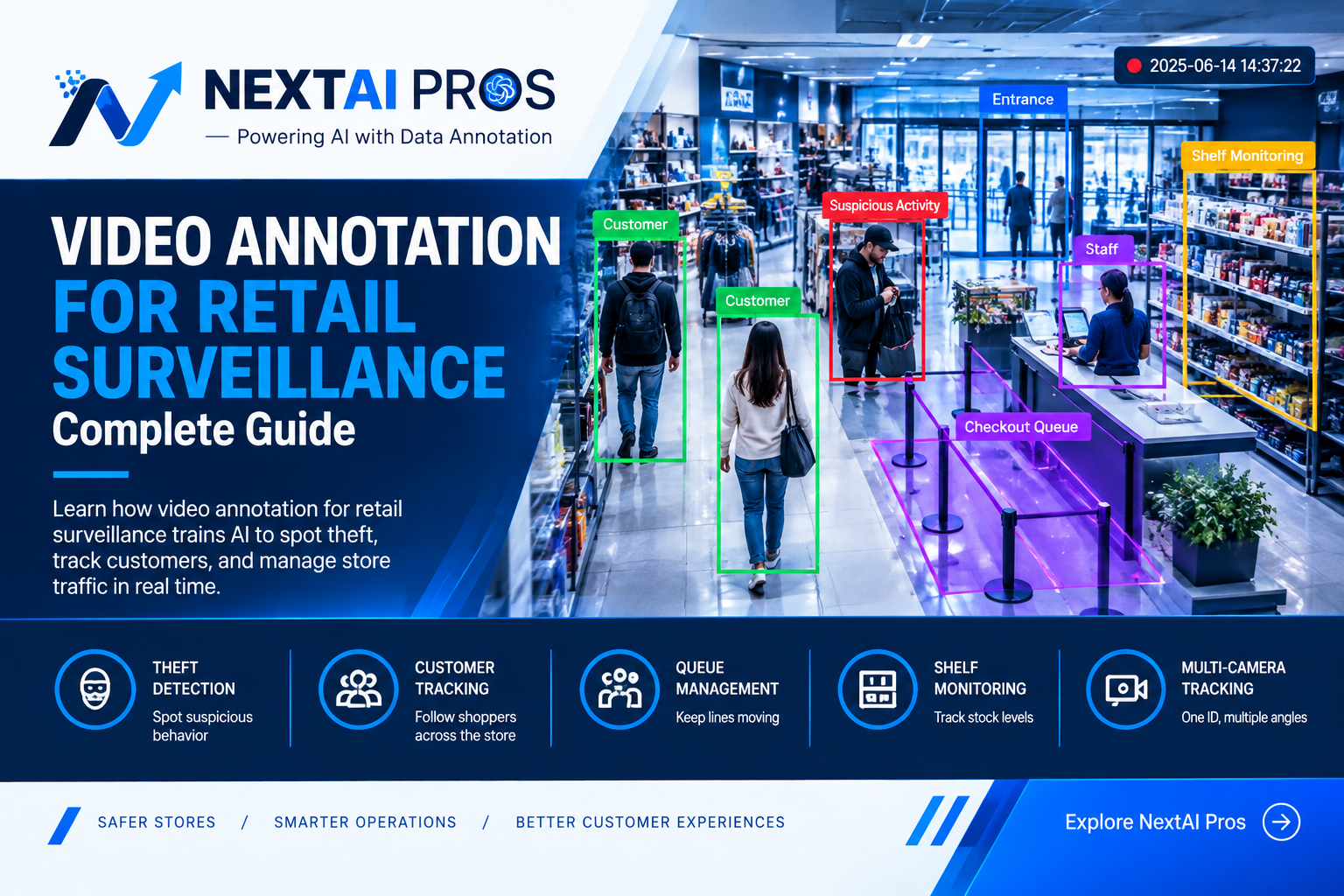
Take a single clip from a store’s ceiling camera near the checkout counter. Before annotation, it’s just a video, nothing more. After annotation, each shopper gets a bounding box that tracks them frame by frame, the checkout line gets marked as a zone, and the moment someone scans an item gets tagged as a labeled action. Do that across thousands of clips and a model starts recognizing normal store behavior on its own, and just as importantly, starts recognizing what looks abnormal.
Why Loss Prevention Systems Fail Without Proper Labeling
Bad labeling of the data set will mislead the algorithm, and the problem will be repeated with every new scene showing the same scenario. Fail to identify some examples of theft during training, and you will either miss the theft in action or, even worse, flag innocent customers continuously and drive staff insane from reviewing every notification.
Video annotation for retail surveillance covers situations that sound small individually but add up fast across a busy store:
- A customer picking up an item, then quietly slipping it into a bag near the fitting rooms
- Someone lingering by the exit doors longer than a typical shopper would
- A shelf that’s gone empty and needs restocking before customers notice
- A checkout line stretching past a length that calls for another register to open
- A staff member scanning an item that never actually gets bagged
- Two people entering together and splitting up in different directions through the store
None of these are dramatic on their own. That’s exactly why a model needs hundreds of labeled examples of each one before it can reliably flag the real problems.
How Store Footage Turns Into a Working Surveillance Model
Building a usable dataset from raw camera footage follows a fairly consistent process, whether it’s a single store or a chain with locations across several states.
- Define the use case. The team decides whether the priority is theft detection, customer flow tracking, checkout monitoring, or some combination of all three.
- Write clear labeling guidelines. Rules need to spell out, for example, exactly when “picking up an item” crosses into “concealing an item,” so different annotators label it the same way.
- Annotate the footage. Using tools like CVAT or Supervisely, annotators apply bounding boxes, polygons, and action tags across each frame or clip.
- Track objects across multiple cameras. Larger stores need consistent IDs so the same shopper stays correctly tracked as they move between camera angles.
- Run quality control. A second reviewer checks labeled clips against the guidelines before the dataset ships to the machine learning team.
Note: Multi-camera tracking is where a lot of retail projects run into trouble. If the same shopper gets assigned a new ID every time they walk under a different camera, the whole point of tracking their path through the store falls apart.
The Core Annotation Techniques Used in Retail Surveillance
Different parts of a retail surveillance system need different labeling approaches, since tracking a person is not the same task as tracking a shelf.
Bounding Box and Polygon Annotation
Bounding boxes mark people, products, and shopping carts with a simple rectangle. Polygons handle trickier shapes, like a hand reaching into a shelf at an angle a box can’t capture cleanly.
Action and Event Segmentation
This labels specific moments within a clip, someone picking up a product, placing it in a cart, or walking toward the exit. Instead of labeling a whole video as one thing, the model learns to recognize distinct actions inside it.
Multi-Camera Tracking
Larger stores rely on several overlapping cameras. This technique keeps one consistent ID assigned to each shopper as they move from one camera’s view into another’s, which matters for tracking a full path through the store rather than disconnected snippets.
Zone and Heatmap Annotation
Specific areas, like checkout lines or high-traffic aisles, get marked as zones. Over time, this data builds heatmaps showing where customers spend the most time, useful for layout decisions as much as security.
Technique | Best For | Example |
Bounding Box | Fast object tracking | Shoppers, carts, products |
Polygon | Irregular shapes and angles | A hand reaching into a shelf |
Action Segmentation | Labeling specific behaviors | Picking up, concealing, scanning |
Multi-Camera Tracking | Consistent ID across angles | A shopper moving store-wide |
Zone Annotation | Marking fixed areas | Checkout lines, entrances |
Where Retail Surveillance Data Gets Put to Work
A flagship store on Michigan Avenue in Chicago would have different traffic patterns compared to a suburban store near a shopping mall in Aventura, Florida. Foot traffic, store layout, and even window lighting in the storefront all contribute to the different learning needs of a machine learning model.
The primary concern for most retailers is loss prevention and relies on labeled examples of concealment behaviors in and around the fitting rooms and the self-checkout kiosks, an area where theft has seen increased activity due to the introduction of unattended checkout areas in many stores. Customer tracking is right behind it, analyzing the path taken by customers based on labeled examples to determine which aisles get skipped and which receive the most attention.
Queue management shares similar data. The queue can be monitored for any build-up that might trigger a notification to the store staff before customers walk out of the store due to the long wait. Inventory monitoring uses similar principles to flag instances of empty and full shelves.
Where a Person Still Has to Make the Call
Automated detection tools have gotten better at flagging obvious theft, a person grabbing an item and sprinting for the door is not hard to catch. Subtler behavior is a different story, and this is where human reviewers still matter.
Some decisions really do require human judgment: figuring out whether a loiterer by the aisle is suspicious or simply uncertain, checking a self-service system transaction that could have been a simple error, and recognizing when a false positive will lead to an unneeded conflict with the customer because of the human ability to read context.
Automated systems are fast at identifying potential issues. They are not particularly good at context.
Real Challenges Retail Annotation Teams Run Into
There are just a few common issues that arise in this type of project, but none of them are particularly exotic once you take a look at what goes on in an active retail environment.
Light conditions are changing all day long, especially near the storefronts, which means that it becomes increasingly hard for the model to recognize objects at the same place. The issue of occlusions is practically constant in such conditions, since shelf, shoppers, and clothing racks are always partially occluding the view of the person being analyzed.
Camera handoff becomes a serious challenge in bigger stores. It requires a very deliberate and carefully performed identification of the same person when he or she moves between the field of vision of different cameras. Privacy compliance makes things even more complicated, since video with identifiable faces must be processed in accordance with regional laws, no matter whether it was captured in the US or Pakistan.
Beyond Loss Prevention
Video annotation for a retail surveillance system supports more than catching theft. Workforce management teams use labeled footage to understand staffing needs during peak hours. Marketing teams use anonymized movement data to test store layouts before a full redesign. Facilities teams even use labeled footage to spot safety hazards, a spill left too long in an aisle, or a blocked emergency exit that needs attention.
The underlying labeled data ends up serving departments well beyond security, even though it started as a surveillance tool.
More Footage Doesn’t Automatically Mean a Better Model
More video hours recorded would mean better detection. This is not the case. Ten thousand hours of empty, silent aisle do not teach the algorithm nearly as much as five hundred samples of actual concealment behaviors, busy checkout scenarios, and edge cases. The more targeted dataset will always beat the large unlabeled dataset.
The desire to look for a free tool or a free PDF check list is reasonable. Open source tools such as CVAT work perfectly fine for small-scale pilot projects. As soon as a retail business exceeds a few cameras, however, the volume of labeling and quality control will increase sufficiently for the labelers to be employed.
How NextAI Pros Handles Retail Surveillance Annotation
At NextAI Pros, we treat video annotation for retail surveillance as a detail-heavy job, not a bulk-processing task. Every labeled clip goes through human review, so a mislabeled action near a self-checkout doesn’t quietly make it into a training set that a retailer ends up relying on.
Our video annotation team handles bounding boxes, action segmentation, and multi-camera tracking across store footage, using industry-standard tools to keep labeling consistent from one location to the next. For retailers building out full monitoring systems, our security and surveillance page covers the broader range of work we do across loss prevention, access control, and public safety footage.
Want to see how your store footage would hold up as training data? Book a discovery call with our annotation team and we’ll walk through your setup, no pressure, no generic sales pitch.
Frequently Asked Questions
What is video annotation for retail surveillance?
It’s the process of labeling people, actions, and events in store camera footage so AI models can detect theft, track customer movement, and monitor checkout activity automatically.
Why does labeling matter for a retail surveillance system?
Without labeled data, a system has no reference for what normal shopping behavior looks like versus theft or unusual activity. Accurate labels directly affect how reliably the system flags real issues.
What annotation techniques are used most in retail surveillance?
Bounding box annotation, action and event segmentation, multi-camera tracking, and zone annotation are the techniques used most often to train retail surveillance models.
Is there a free way to start with retail video annotation?
Open-source tools like CVAT work fine for small pilot projects. Once a retailer scales past a few cameras, a dedicated annotation team usually handles the volume and quality control more reliably.
Is automation enough to completely replace human analysis for loss prevention?
Not at the moment since while automated systems can detect simple acts of stealing, human analysis is better at detecting complicated acts of stealing and false negatives which automatic systems tend to interpret incorrectly.
At NextAI Pros, our clients are not just customers — they’re valued partners in every project. We offer personalized support to help you navigate your AI data journey, from choosing the right annotation approach to understanding your project’s unique requirements. Whether it’s answering your queries or providing expert guidance on data strategy and implementation, NextAI Pros is with you every step of the way.
Categories
- Image Annotation
- Video Annotation
- Text Annotation
- Audio Annotation
- LiDAR Annotation