
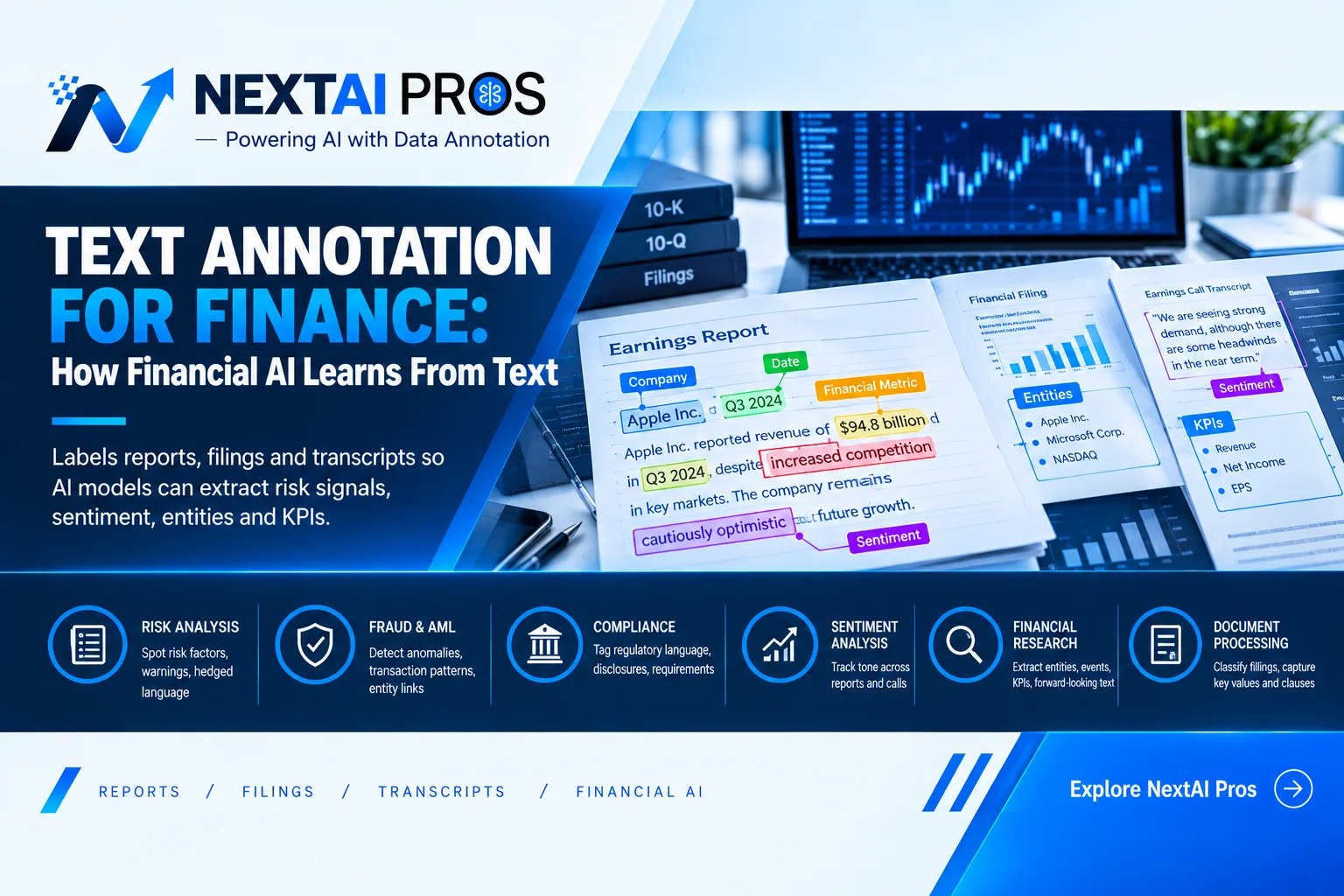
Text Annotation for Finance: How Financial AI Learns From Text
While an analyst on Wall Street may breeze through an earnings call transcript and spot immediately the important sentence, a caution about declining revenues or a new filing with the SEC, a general language model will be able to detect the text, but the specific AI trained in finance still requires structured domain-specific data to pick out the key information. Text annotation for finance, the kind of work teams like NextAI Pros handle, is what builds that structured data in the first place.
Sept 21 2026
Text Annotation
What Financial Text Annotation Actually Means
Text annotation is a process where certain words, phrases, or sentences in a piece of text are annotated with tags to denote their significance. It is basically the textual equivalent of the concept behind image labeling, except that instead of labeling a certain region of an image to mark a car, a human annotator marks a phrase in a document and labels it as being a company name, dollar figure, risk statement, or anything else.
Consider an example of such labeled data. The statement, “We saw revenue growth of 8% in Q3, despite increased material costs.” would be annotated as having Q3 marked as a date, 8% as a financial metric, rising material costs as a risk factor, and the entire statement getting a sentiment of cautiousness. This is what a machine learning model is trained on.
Why Financial Document Annotation Matters
AI models that have not been fed proper labels for the financial documents could fail to differentiate between mundane and critical information. This is a huge issue because the failure to identify a risk disclosure within a highly technical filing, or a change in tone during an earnings call discussion is simply missed.
Financial document annotation can be seen everywhere analysts encounter daily in their work. Noting risk disclosures in a very long 10-K or 10-Q filing. Labeling the tone changes that appear in an earnings call transcript. Finding companies, ticker symbols, and monetary amounts in a report. Identifying contract sections that contain payment information or liabilities. Spotting potential fraud signals in transaction description and internal memo. Categorizing analyst notes according to the subject – such as liquidity, revenue, or compliance.
Not one of these is a one-off task. The model needs thousands of examples in each category before it learns to detect it in new financial documents.
Financial Text Annotation Use Cases
Use Case | What Gets Labeled |
Risk Analysis | Risk factors, warnings, hedged language |
Fraud Detection | Suspicious transaction patterns, anomaly indicators |
AML | Transaction risk signals, entity relationships |
Regulatory Compliance | Compliance language, disclosure requirements |
Sentiment Analysis | Positive, negative, neutral tone across text |
Financial Research | Entities, events, KPIs, forward-looking statements |
Document Processing | Fields, clauses, key values in structured filings |
Techniques Used In Financial Text Annotation
Different parts of a financial document call for different labeling approaches.
Named Entity Recognition And Sentiment Labeling
Named entity recognition tags specific entities like company names, tickers, dates, and dollar amounts, usually the first layer applied to any financial document before deeper labeling begins. Sentiment labeling tags sentences or full sections as positive, negative, or neutral, useful for tracking tone shifts across earnings calls or analyst commentary over time.
Relation Extraction And Risk Classification
Relation extraction labels the relationship between two tagged entities, for example connecting a company name to a specific revenue figure mentioned in the same sentence. Risk and intent classification tags sentences by purpose, a risk disclosure, a forward-looking statement, a routine operational update, or a genuine customer intent behind a support query or compliance flag, which helps a model prioritize what actually needs attention.
Event Extraction, KPI Extraction, And Document Classification
Event extraction identifies specific occurrences within text, a merger announcement, a leadership change, a guidance revision, tying that event to the entities and dates involved. Financial metric and KPI extraction pulls out figures like revenue, margins, and guidance directly from unstructured text, structuring them into something a model or a dashboard can actually use. Document classification sorts entire filings or reports by type or topic before deeper annotation even begins, useful for routing regulatory documents to the right review process.
Technique | Best For | Example |
Named Entity Recognition | Tagging key data points | Company names, dates, amounts |
Sentiment Labeling | Tracking tone | Earnings call transcripts |
Relation Extraction | Connecting related entities | Linking a figure to its source |
Risk and Intent Classification | Flagging important sections | Risk disclosures in a 10-K |
Event Extraction | Identifying occurrences | Mergers, leadership changes, guidance revisions |
KPI Extraction | Structuring financial metrics | Revenue, margins, guidance figures |
Document Classification | Sorting documents by type | Routing filings for regulatory review |
How A Financial Document Becomes Labeled Training Data
Getting from a raw report to usable training data follows a fairly consistent process. The team defines what needs tagging first, deciding whether the priority is entities, sentiment, risk language, or a mix of all three. Labeling guidelines get written carefully, since financial language is often vague on purpose, and two annotators need to tag it the same way. Annotators then work through the text in a labeling tool, highlighting and tagging spans according to the guidelines. A second annotator reviews labeled documents against the guidelines before anything moves forward, and the finished dataset gets exported in a format the model can train on.
Financial language often hedges on purpose, phrases like “may result in” or “could potentially impact” are common. Guidelines need to spell out exactly how to label hedged language, or annotators will tag it inconsistently across a dataset. Teams handling this kind of text and NLP annotation work through the same discipline regardless of the document type.
Fraud Detection And AML Annotation
Anti-fraud and money laundering activities require the use of labeled text significantly. In these processes, transactions, internal notes, and customer communications are annotated based on suspicious patterns, anomalies in phrasing, inconsistencies in entities and their relationships, or inappropriate language in regard to the purpose of the transaction. Anti-money laundering labeling concentrates on annotating the entities and relationships related to the transaction itself and putting together name-account and amount in such a way that the system could check them against the watch list and risk levels.
This is one of the more complicated types of financial text annotation as false negatives may have some legal ramifications, while false positives would add unnecessary work to the compliance department which is already overwhelmed.
Regulatory Compliance Annotation
Regulatory documents must meet a certain standard that is distinct from the normal standard of an earnings report. Compliance annotation refers to tagging terms linked to regulatory requirements, noting when an earnings report meets or does not meet particular regulations it should have complied with. Such classification and compliance annotation must stand alone most of the time because the compliance department will have to justify the classification or annotation.
Where This Shows Up Across Finance Teams
The process of financial document annotation is not limited to only one department. The accounting department leverages labeled datasets to detect any discrepancies between the data reported and supporting evidence. The operations department uses the annotated data to categorize the internal communication based on its level of urgency or topic.
The compliance department relies on annotated filings to detect risk statements that require legal review before the filing becomes public. The investment research department uses sentiment-labeled transcripts to monitor any changes in tone adopted by executives, which typically serves as an early warning signal before changes in actual performance.
Where A Human Reviewer Still Catches What A Model Misses
Automated tagging tools handle basic entity recognition well at this point, spotting a dollar figure or a date is straightforward. Nuance is a different story. A phrase like “we remain cautiously optimistic” carries real meaning to a trained analyst that an automated sentiment tool often misses entirely.
Some judgment calls still need a person. Deciding whether hedged language counts as a genuine risk disclosure. Catching sarcasm or understatement in an executive’s remarks. Confirming labels stay consistent across documents written in very different styles. Reviewing edge cases where a single sentence touches on multiple topics at once.
Real Challenges With Financial Text Annotation
Financial language is dense and full of jargon, which means annotators need domain familiarity before they can label accurately, a general annotator without finance background will misclassify terms regularly. Ambiguity is a constant issue too, since the same phrase can mean something different depending on which section of a report it appears in.
Document length adds friction as well. A single 10-K filing can run over a hundred pages, and maintaining consistent labeling across that much text takes real discipline. Confidentiality matters more here than in most other annotation work, since financial documents often contain sensitive, non-public information that needs careful handling throughout the process.
Financial Text Annotation Beyond Reports And Filings
The same tagging discipline extends past traditional financial reports. Legal teams use it to label contract clauses and case law. Healthcare teams use it to tag clinical notes for research. Customer support teams use it to classify tickets by urgency and topic. The underlying labeling process, entities, sentiment, intent, relationships, stays largely the same across industries, even as the domain vocabulary changes.
More Labeled Text Does Not Mean A Better Model
It’s tempting to think a bigger labeled dataset always wins. It usually doesn’t. A thousand nearly identical, routine earnings statements teach a model far less than a few hundred varied examples covering genuine risk language, mixed sentiment, and unusual phrasing. Quality control matters more than raw document count.
How NextAI Pros Approaches Text Annotation For Finance
NextAI Pros delivers text and NLP annotation, including named entity recognition, sentiment labeling, and intent tagging, as part of a broader data annotation offering that also covers image, video, audio, blueprint, and 3D point cloud data. Every batch goes through a triple level QA process aimed at 99%+ accuracy, with 8+ years of experience and 30+ annotators working across projects for clients in the US, UK, Europe, and UAE.
For financial text work specifically, that means entity tagging, sentiment labeling, and intent classification applied to reports, filings, and transcripts, with human review built into the process rather than relying on automated tagging alone.
Have financial documents that need structured, reviewed labeling. Reach out at info@nextaipros.com or visit nextaipros.com to talk through what your project needs.
Frequently Asked Questions
What is text annotation?
Text annotation is the process of tagging words, phrases, or sentences in a document with labels that explain what they mean, used to train AI models to understand text the way a person would.
What is text annotation in NLP?
In natural language processing, text annotation provides the labeled examples a model needs to learn tasks like entity recognition, sentiment analysis, and classification.
Why does finance need specialized text annotation?
Financial language is dense, hedged, and full of jargon. General annotators without financial background often mislabel risk statements and sentiment, so domain familiarity matters more here than in general text labeling.
What is financial document annotation used for?
It’s used to flag risk language, tag entities like company names and figures, extract KPIs, and label sentiment across earnings reports, filings, and transcripts for both compliance and research purposes.
How is fraud detection annotation different from general sentiment labeling?
Fraud detection annotation focuses on tagging suspicious patterns and mismatched entity relationships in transaction data, while sentiment labeling tracks tone across text like earnings calls. Both often get used together in a financial NLP pipeline.
What is event extraction in financial text?
It identifies specific occurrences in text, like a merger announcement or a guidance revision, and ties that event to the entities and dates involved.
Does NextAI Pros provide financial text annotation?
Yes, the team handles named entity recognition, sentiment labeling, and intent tagging as part of its broader text and NLP annotation work, with human review on every batch.
At NextAI Pros, our clients are not just customers — they’re valued partners in every project. We offer personalized support to help you navigate your AI data journey, from choosing the right annotation approach to understanding your project’s unique requirements. Whether it’s answering your queries or providing expert guidance on data strategy and implementation, NextAI Pros is with you every step of the way.
Categories
- Image Annotation
- Video Annotation
- Text Annotation
- Audio Annotation
- LiDAR Annotation