
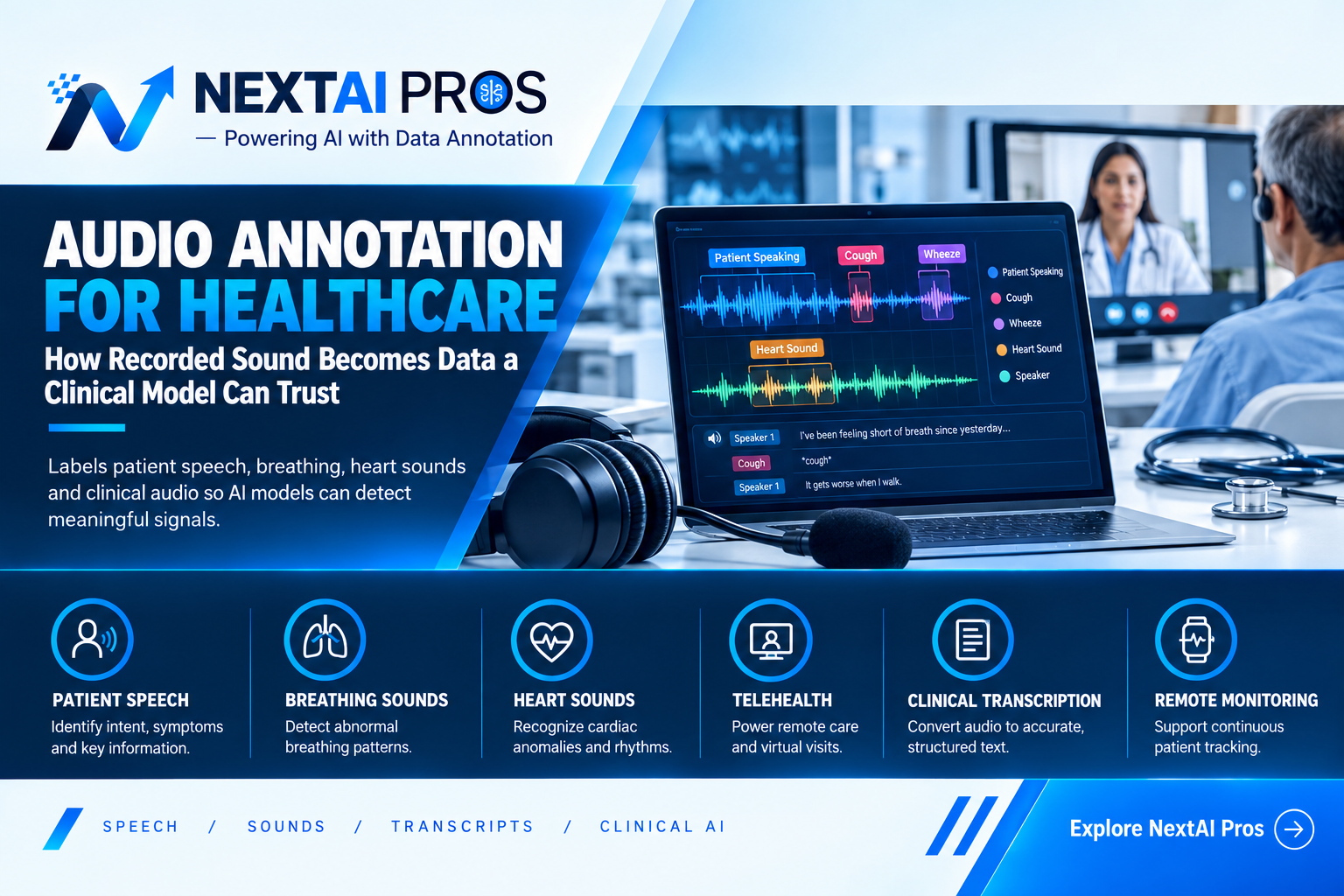
Audio Annotation for Healthcare: How Recorded Sound Becomes Data a Clinical Model Can Trust
A stethoscope picks up a heartbeat the same way it has for two hundred years. What's changed is what happens to that sound afterward. A recording of a heartbeat, a cough, or a patient describing symptoms over a telehealth call can now train a model to recognize patterns a doctor would catch by ear. None of that works without someone first labeling what's actually in the recording. That labeling work is audio annotation for healthcare.
Sept 25 2026
Image Annotation
Audio annotation for healthcare means labeling recorded sound, like patient speech, heartbeats, or breathing patterns, so AI models can detect clinical signals automatically. Annotators mark specific segments of audio with tags, turning raw recordings into structured data a healthcare model can learn from.
Key Takeaways
- It is the process of labeling speech, breath, or heartbeat sounds of a patient to teach the model how to detect clinical patterns.
- Applications may include clinical symptom detection, clinical transcription, and remote patient monitoring.
- Audio labeling methods may be speaker diarization, sound event labeling, and medical transcription.
- Annotation tasks for audio may be found on healthcare-focused and gig work platforms with significantly varied rates.
- Contextual information is detected by human verification which is not possible for an all-round speech recognition model.
What Audio Annotation for Healthcare Actually Involves
A microphone only captures sound pressure fluctuations. It doesn’t care whether the cough is a dry one or productive, whether the gap in someone’s speech during a telehealth session indicates confusion or mere contemplation. Annotation is what provides the medical context.
The following is a simple example of annotation. Thirty seconds worth of a recording from a remote patient monitoring telehealth session is annotated into three segments. One starts at 0:04 and ends at 0:09 (patient speaking); the next one starts at 0:12 and ends at 0:14 (cough, dry); the entire clip tone is described as “mild respiratory distress.” It is this annotated data and not an unannotated audio file that the clinical model is trained on.
Why Unlabeled Clinical Audio Doesn’t Do Much
An unlabeled recording in a database is unable to alert anyone by itself. This deficiency becomes even more critical in the medical field because the missed signal could very well have been the one that was really needed.
Healthcare Audio Annotation allows to deal with situations that occur on a regular basis in clinical practice and remote medicine: Identification of heart arrhythmias or heart murmur from recorded auscultation sound
- Detection of breathlessness, wheezing or continuous cough from the recording of the monitoring call
- Transcription of patient-practitioner dialogue with speaker diarization
- Detection of the slurred speech that may indicate some neurological disorder
- Annotation of mental health screening call in terms of tone or pace of speech
- Distinguishing the actual medical signal from the background noise from the recording made at the patient’s home
Each of them happens not very often but still quite frequently in large-scale practice. Hundreds or even thousands of labeled samples will be needed for a machine learning algorithm.
How a Raw Recording Becomes Usable Clinical Data
Turning raw audio into something a model can train on follows a fairly consistent process.
- Define what needs tagging. The team decides whether the priority is speech transcription, sound event detection, or both.
- Write labeling guidelines. Rules need to spell out exactly how to classify ambiguous sounds, since a wet cough and a throat clear can sound nearly identical to an untrained ear.
- Annotate the audio. Using a labeling tool, annotators mark timestamps, tag events, and transcribe speech according to the guidelines.
- Apply speaker diarization. In multi-speaker recordings, each speaker gets consistently labeled across the full clip, patient, clinician, caregiver.
- Review for accuracy. A second annotator checks labeled clips against the guidelines before the dataset ships.
Note: Background noise is one of the most common sources of inconsistent labeling in home-recorded healthcare audio. Guidelines need to clearly separate real clinical signal from a television playing in the next room, or annotators will label it differently clip to clip.
Techniques Used in Healthcare Audio Annotation
Different kinds of clinical audio need different labeling approaches.
Speaker Diarization
This separates and labels who is speaking at each point in a recording, important for transcripts involving a patient, a clinician, and sometimes a caregiver or interpreter.
Sound Event Tagging
Specific non-speech sounds get marked with timestamps, a cough, a wheeze, a heartbeat irregularity, so a model learns to recognize the acoustic signature of each one.
Transcription With Clinical Context
Spoken words get transcribed alongside medical terminology tags, so a model understands not just what was said, but which parts carry clinical significance.
Sentiment and Distress Labeling
Tone and pacing across a call get labeled to flag signs of confusion, distress, or anxiety, useful for mental health screening and triage calls.
Technique | Best For | Example |
Speaker Diarization | Multi-speaker clarity | Patient-provider calls |
Sound Event Tagging | Non-speech clinical signals | Coughing, wheezing, heartbeats |
Clinical Transcription | Structured text output | Dictation, consultations |
Distress Labeling | Tone and risk signals | Mental health screening calls |
Where This Data Gets Used Across Care Settings
The application of remote patient monitoring applications depends on labeled audio data because a model predicting the worsening of respiration condition between two consecutive visits must be shown how an early warning sounds. The telemedicine platform also utilizes labeled audio to determine whether a call needs a quicker response based on the pattern of speech; hence, a person who might be confused is redirected accordingly.
Another application of labeled audio data is clinical documentation. In this case, labeled audio of dictation and consultation will train a transcription model to filter out a doctor’s dictation from other conversations. The mental health application utilizes labeled distress audio data to create screening tools where calls showing a certain tone or pace should be attended to promptly.
Audio Annotation Jobs: What the Work Actually Pays
Indeed, quite a large number of people interested in this issue are looking for the job, so let us just be straightforward. The price offered for audio annotation is highly variable depending on the platform and the domain in question.
The tasks available on general platforms for gig work or microtasks tend to have very little payment, at times less than one dollar for one audio clip, without any certainty in the volume of tasks. This type of work is suitable for someone looking for extra money but not a constant wage. On the other hand, specialized healthcare audio annotation is a different level as it presupposes the knowledge of medical terminologies and sensitive dealing with the patient data in compliance with specific regulations. As per the recent data provided by ZipRecruiter, data annotation positions in the USA have annual salaries of about $52,000 or hourly payments of $25. Healthcare and clinical positions will definitely have higher salaries because of the need for domain expertise.
When choosing between these two alternatives, one should consider the issue of training, regularity, and data sensitivity.
Where a Trained Reviewer Still Beats Automated Transcription
Speech-to-text software is capable of accurately converting well-recorded audio with one speaker. Clinical audio files are not always this simple. Whispering through a mask, overlapping speech during a family counseling session, or accents pose problems for automatic transcription which an experienced annotator recognizes right away.
Sometimes manual annotation is necessary: differentiating a real wheeze from environmental noise, ensuring that the slurred speech was not caused by bad recording quality, recognizing sarcasm or a reserved tone in a mental health call, and maintaining consistency between annotations made on very different quality devices and connections.
Real Challenges Teams Face With Clinical Audio
There are some common issues that keep appearing in this task. One such is background noise, which becomes quite prevalent in home-recorded telehealth audio, where there is a good chance of having a TV or even a cat or another person in the home interfere with the actual signal. Accent and dialect differences also pose challenges, as a model trained primarily on one speech pattern will misinterpret the others when the training set is not diversified intentionally.
Compliance and privacy concerns are more important in this context than in other annotation tasks, since patient audio falls under the category of protected health information, which has to be regulated according to certain standards during the entire process of labeling, not only the final stage. Rare clinical phenomena, like uncommon heart arrhythmia, for example, are rather hard to find enough labeled examples of because they are just not common.
Beyond Clinical Settings
Audio annotation for healthcare overlaps with work happening in adjacent fields. Elder care monitoring platforms use similar labeled audio to detect falls or distress calls in a home setting. Fitness and wellness apps use labeled breathing pattern data for recovery tracking. Veterinary audio research applies nearly identical labeling techniques to detect illness in animal sounds. The underlying skill, accurately labeling sound with real-world context, carries across all of it.
More Recordings Doesn’t Mean a Better Model
It’s tempting to assume more recorded hours automatically improves a clinical model. It doesn’t help much without careful labeling behind it. A thousand hours of routine, healthy breathing teaches a model far less than a few hundred clips covering genuine respiratory distress, varied accents, and real background noise conditions. Quality control matters more than raw recording volume.
How NextAI Pros Handles Audio Annotation for Healthcare
At NextAI Pros, audio annotation for healthcare gets treated as a compliance-aware, detail-heavy task, not generic labeling work. Every clip our team tags goes through human review before it reaches a client, so a mislabeled clinical signal doesn’t quietly make it into a training set a care team ends up relying on.
Our audio annotation services cover speaker diarization, sound event tagging, and clinically contextualized transcription across patient monitoring and telehealth audio. For projects that also involve labeled video, like in-cabin or remote monitoring footage, our video annotation team covers that layer too.
Want to see how your clinical audio would hold up as labeled training data? Book a discovery call with our annotation team and we’ll walk through what your project actually needs.
Where This Is Headed
A recording by itself tells a care team nothing until someone labels what’s actually in it. That work happens clip by clip, patient call by patient call, mostly out of sight. As remote monitoring and telehealth keep expanding, the need for accurate, compliant audio labeling keeps growing right along with it.
Frequently Asked Questions
What is audio annotation for healthcare?
It’s the process of labeling recorded sound, like patient speech, heartbeats, or breathing patterns, so AI models can detect clinical signals and support diagnosis or monitoring.
What is an example of audio annotation for healthcare?
A recorded telehealth call gets broken into timestamped segments, with a cough tagged as “dry” or “productive,” and speaker turns labeled between patient and clinician.
What does an audio annotation example actually look like?
It typically includes a timestamped transcript with tags for specific sounds or speech patterns, along with a label describing what each tagged segment represents.
What does an audio annotation job involve?
The role usually involves listening to audio clips and tagging timestamps, speakers, or sound events in a labeling tool, following a set of guidelines for consistency.
How much do audio annotation jobs pay?
Pay varies widely. General microtask platforms often pay a small amount per clip, while specialized healthcare annotation work tends to pay more due to the domain expertise and compliance requirements involved.
Why does healthcare audio annotation need special handling compared to general audio labeling?
Patient audio counts as protected health information, so it needs strict privacy and compliance handling throughout the labeling process, along with annotators familiar with medical terminology.
At NextAI Pros, our clients are not just customers — they’re valued partners in every project. We offer personalized support to help you navigate your AI data journey, from choosing the right annotation approach to understanding your project’s unique requirements. Whether it’s answering your queries or providing expert guidance on data strategy and implementation, NextAI Pros is with you every step of the way.
Categories
- Image Annotation
- Video Annotation
- Text Annotation
- Audio Annotation
- LiDAR Annotation