
AI has become remarkably good at recognizing objects in images. It can identify a person, detect a vehicle, locate a product, or distinguish one type of object from another.
But understanding what is happening in a video is a much harder problem.
A person standing beside a table tells an AI very little. Across a sequence of frames, that same person might pick up an object, place it down, fall, open a door, or interact with another person.
This is the challenge that action recognition aims to solve.
Action recognition models allow computer vision systems to identify and classify activities as they happen over time. They are used in applications ranging from intelligent surveillance and workplace safety to sports analytics, healthcare, robotics, and human-computer interaction.
But these models don’t learn actions from raw video alone. They need carefully labeled examples that show what is happening, where it happens, and when it happens.
That is where high-quality video annotation becomes essential.
What Is Action Recognition?
Action recognition is a computer vision task that enables an AI model to identify activities or behaviors within video.
Unlike traditional image classification, action recognition depends heavily on motion and temporal context.
Consider a single frame showing a person bending forward.
The frame could represent:
- A person picking something up
- Someone sitting down
- A worker inspecting equipment
- A person falling
- Someone tying their shoes
The individual frame may not provide enough information to distinguish between these actions.
When the AI can examine the sequence before and after that frame, the movement becomes much clearer.
This is why action recognition is fundamentally different from simply detecting objects. The model needs to learn not only what is present, but also how it changes over time.
Why Video Annotation Matters for Action Recognition
Raw video contains enormous amounts of visual information, but most of that information is unstructured.
An annotation layer gives the AI model meaningful context.
For example, an annotated video might tell a model:
Person 1 enters the scene → approaches a table → reaches toward an object → picks up the object → walks away.
This creates a relationship between objects, movement, and time.
For action recognition, annotations may identify:
- The person performing an action
- The action category
- The beginning and end of the action
- Objects involved in the activity
- Body positions
- Movement between frames
- Interactions between people and objects
The quality of these labels matters because inconsistent training data can teach a model inconsistent behavior. Video annotation therefore needs to preserve temporal continuity, not just accuracy within individual frames.
How Video Annotation Helps Models Understand Actions
Different action recognition projects require different annotation techniques. The right combination depends on what the model needs to understand.
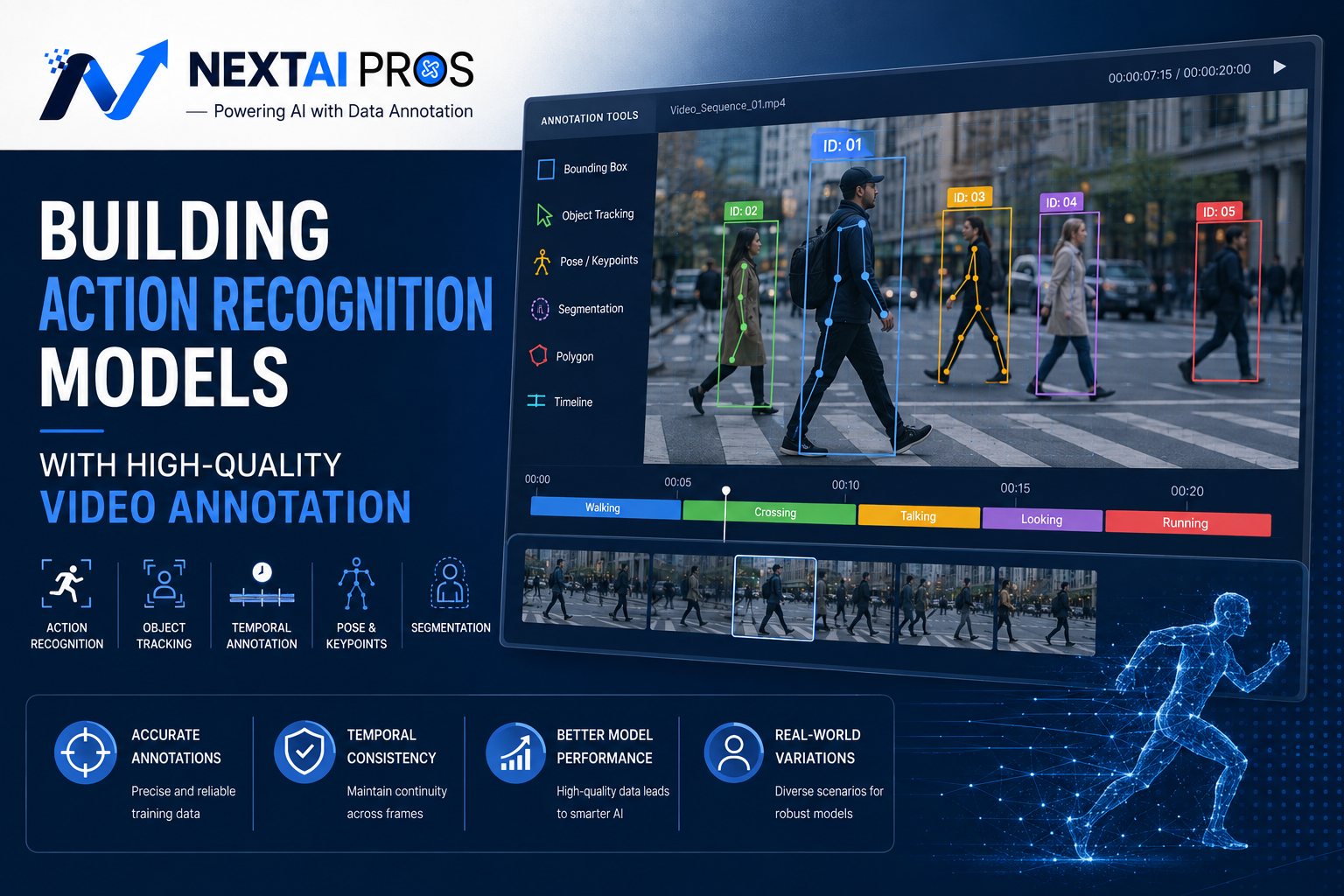
1. Temporal Action Annotation
Actions happen over a period of time, so the dataset needs to capture that period.
For example:
00:08 — Person begins walking
00:12 — Person approaches another person
00:14 — Person stops
00:16 — Person begins talking
Instead of labeling only one frame, temporal annotation identifies the complete duration of an event.
This is particularly important when two activities look similar in individual frames.
A model trained to detect falls, for example, needs to understand the movement leading to the fall—not simply the final position of someone lying on the ground.
2. Object Tracking
Action recognition often depends on knowing which person or object is involved in an activity.
Tracking assigns an identity to an object and maintains that identity across frames.
For example:
- Person 01
- Person 02
- Vehicle 01
- Object 01
If Person 01 picks up a bag, the annotation should allow the model to understand that the same person interacted with the same object throughout the sequence.
Breaking that identity from frame to frame can create confusing training signals for the model.
3. Bounding Boxes
Bounding boxes identify where an object or person appears in each frame.
For action recognition, boxes can provide useful spatial information about the participants involved in an action.
For example, a dataset might track:
- Person
- Ball
- Bat
The model can then learn relationships between the movement of the person and the objects around them.
Bounding boxes are relatively efficient to create and are useful for many tracking and detection applications.
4. Pose and Keypoint Annotation
Some actions cannot be understood well from a person’s bounding box alone.
Pose annotation adds more detailed information by marking body landmarks such as:
- Head
- Shoulders
- Elbows
- Wrists
- Hips
- Knees
- Ankles
This allows AI models to learn body movement and posture.
Pose-based datasets can be particularly useful for sports analytics, exercise monitoring, workplace ergonomics, gesture recognition, and human-computer interaction.
For example, the difference between walking and running may become much clearer when the model can analyze changes in body position across multiple frames.
5. Segmentation
Segmentation provides pixel-level information about an object or person.
This can become valuable when scenes contain overlapping objects or when precise boundaries matter.
For example, in a crowded environment, bounding boxes around several people may overlap significantly. Segmentation can provide the model with a more precise understanding of each person’s visible area.
The appropriate annotation method therefore depends on the level of visual detail required by the AI application.
Why Temporal Consistency Is So Important
One of the biggest differences between image and video annotation is continuity.
An image can be labeled correctly in isolation.
Video requires labels to remain meaningful across a sequence.
Imagine a person walking across 100 frames.
If their tracking identity changes several times, the dataset may contain:
Person 01 → Person 03 → Person 07 → Person 02
even though it is the same person.
The individual frames may technically contain correct bounding boxes, but the sequence has lost its temporal consistency.
The same problem can happen with actions.
If an action starts at frame 40 and ends at frame 80, but annotators label only frames 50–65, the model receives an incomplete representation of the activity.
For action recognition, annotation should therefore capture the full temporal extent of meaningful events wherever the project guidelines require it.
Building a High-Quality Action Recognition Dataset
Creating an effective dataset involves more than labeling as many videos as possible.
1. Define the Action Categories
Start by deciding exactly what the model needs to recognize.
For example:
- Walking
- Running
- Sitting
- Falling
- Picking up an object
- Opening a door
- Fighting
- Entering a restricted area
Definitions should be specific enough that different annotators can consistently distinguish between categories.
2. Collect Representative Video
The training dataset should reflect the conditions in which the model will eventually operate.
If an AI system will analyze surveillance footage, training data should not consist only of perfectly lit, clear videos.
It may need examples involving:
- Different camera angles
- Different lighting
- Crowded scenes
- Partial visibility
- Different environments
- Different body types
- Different movement speeds
- Background activity
Variation helps the model generalize beyond the exact videos it saw during training.
3. Create Clear Annotation Guidelines
Annotation guidelines should explain exactly how actions and objects should be labeled.
They should also address difficult cases.
For example:
What should happen when an action starts before the video clip?
What if a person becomes hidden behind an object?
What if two actions overlap?
What if an activity is only partially completed?
Without clear rules, different annotators may make different decisions about the same footage.
4. Annotate the Video
Once the taxonomy and guidelines are established, annotators can label the video using the appropriate techniques.
Depending on the project, that may include temporal labels, bounding boxes, tracking IDs, keypoints, segmentation masks, or activity classifications.
5. Perform Quality Control
Quality assurance is especially important for video because a single mistake can affect many consecutive frames.
Review processes can identify:
- Incorrect action labels
- Missing annotations
- Broken tracking identities
- Incorrect timestamps
- Inconsistent object labels
- Poor keypoint placement
- Incorrect action boundaries
Automated checks can help identify potential problems, while human reviewers can handle ambiguous cases.
Common Challenges in Action Recognition Datasets
Occlusion
People and objects frequently disappear behind other objects.
A person may walk behind a vehicle and reappear several seconds later.
The annotation process needs rules for maintaining identity through these situations.
Similar Actions
Some activities look almost identical for a short period.
For example:
Bending down vs. falling
Walking vs. running
Picking up vs. reaching
The surrounding frames provide the context needed to distinguish them.
Camera Movement
A moving camera can make it difficult to determine whether an object is moving or the camera itself is moving.
Training data should include representative camera conditions where relevant.
Motion Blur
Fast movement can create blurred frames, making precise annotation difficult.
These frames may require additional review or specific project guidelines.
Crowded Scenes
Multiple people performing different activities simultaneously increase the complexity of tracking and action classification.
The dataset needs to represent these situations if the final model will encounter them.
Real-World Applications of Action Recognition
Action recognition is useful anywhere AI needs to understand activity rather than simply identify objects.
Security and Surveillance
Video AI can be trained to recognize activities such as:
- Entering restricted areas
- Falling
- Fighting
- Abandoned-object events
- Unusual movement
- People gathering
This can support intelligent surveillance systems and automated video analysis.
Workplace Safety
Action recognition can help identify potentially unsafe activities, such as falls, incorrect equipment handling, or people entering hazardous areas.
The goal is not simply to detect workers, but to understand what they are doing.
Sports Analytics
Sports platforms can use action recognition to analyze:
- Player movement
- Running
- Passing
- Shooting
- Tactical behavior
- Body positioning
Pose and temporal annotation can provide particularly valuable training data for these applications.
Healthcare
Video-based AI can potentially support applications such as fall detection, movement monitoring, rehabilitation analysis, and activity recognition.
These systems require carefully designed datasets because false detections can have serious consequences.
Robotics
Robots operating around humans need to understand movement and interactions.
Action recognition can help systems interpret activities such as walking, reaching, lifting, or handing an object to another person.
Human Annotation and AI-Assisted Workflows
Modern annotation workflows don’t necessarily require every frame to be labeled completely from scratch.
AI-assisted tools can generate preliminary annotations, track objects between frames, or interpolate labels between keyframes.
Human annotators can then review and correct those predictions.
This creates a human-in-the-loop workflow:
AI prediction → Human review → Correction → Quality check → Final dataset
The advantage is that automation can handle repetitive work while humans focus on difficult or ambiguous cases.
For large video datasets, strategies such as keyframe interpolation and model-assisted annotation can improve efficiency, but they still need appropriate validation to ensure temporal accuracy.
Why Data Quality Ultimately Determines Model Quality
It is tempting to measure an annotation project by the number of frames labeled.
But more data isn’t automatically better data.
A smaller dataset with clear definitions, consistent tracking, representative examples, and strong quality control can be more useful than a much larger dataset filled with inconsistent labels.
This connects directly to a broader principle in machine learning: the model can only learn patterns that are represented correctly in its training data.
For action recognition, that means the dataset should accurately represent:
what happened + who did it + where it happened + when it happened + how the action progressed.
The better those relationships are captured, the stronger the foundation for the model.
How NextAI Pros Approaches Video Training Data
At NextAI Pros, we work with AI training data across different modalities, including image, video, text, and other datasets.
For video-based AI, the focus is not simply on labeling individual frames. The annotation workflow needs to preserve the relationships between objects, actions, and time.
That may involve tracking, temporal labeling, activity classification, keypoints, segmentation, and quality validation depending on the requirements of the project.
The same principle applies across AI projects: annotation should be designed around what the model needs to learn.
You can also learn more about the role of reliable training data in our guide to ground truth data in machine learning.
Final Thoughts
Action recognition is one of the more demanding areas of computer vision because understanding an activity requires more than identifying what appears in a single image.
AI needs to understand movement, sequence, interaction, and context.
High-quality video annotation provides that structure.
Temporal labels show when actions occur. Tracking connects objects across frames. Pose annotation captures body movement. Segmentation provides precise visual boundaries. And quality control helps ensure that these labels remain consistent throughout the dataset.
As action recognition becomes more useful across surveillance, healthcare, sports, robotics, and workplace safety, the quality of the underlying video data will remain a critical part of building reliable AI systems.
The better an AI model understands its training examples, the better prepared it is to understand the real world.