
Most AI teams spend a lot of time thinking about models. But before a model can make a reliable prediction, it needs something equally important: reliable data to learn from.
That is where ground truth data comes in.
Ground truth provides a trusted reference for determining whether an AI model, annotation team, or automated labeling system is getting things right. It can be used to train machine learning models, evaluate predictions, measure annotation quality, and identify problems before they affect a production system.
But creating ground truth isn’t simply a matter of labeling a few files and calling them “correct.”
The quality of the benchmark matters. The people creating it matter. The annotation guidelines matter. And, in many real-world projects, reasonable people can disagree about what the correct label should be.
In this guide, we’ll explain what ground truth data means, how it differs from ordinary labeled data, how teams can build a reliable ground truth dataset, and where human annotation fits into the process.
What Is Ground Truth Data?
Ground truth data is a carefully reviewed dataset that represents the reference answer used to evaluate or guide an AI or machine learning system.
Think about an exam.
A student answers 100 questions, but you need an answer key to determine how many answers are correct.
Ground truth plays a similar role in machine learning.
A model produces a prediction, and the prediction can be compared against a trusted label or reference to determine how well the model performed.
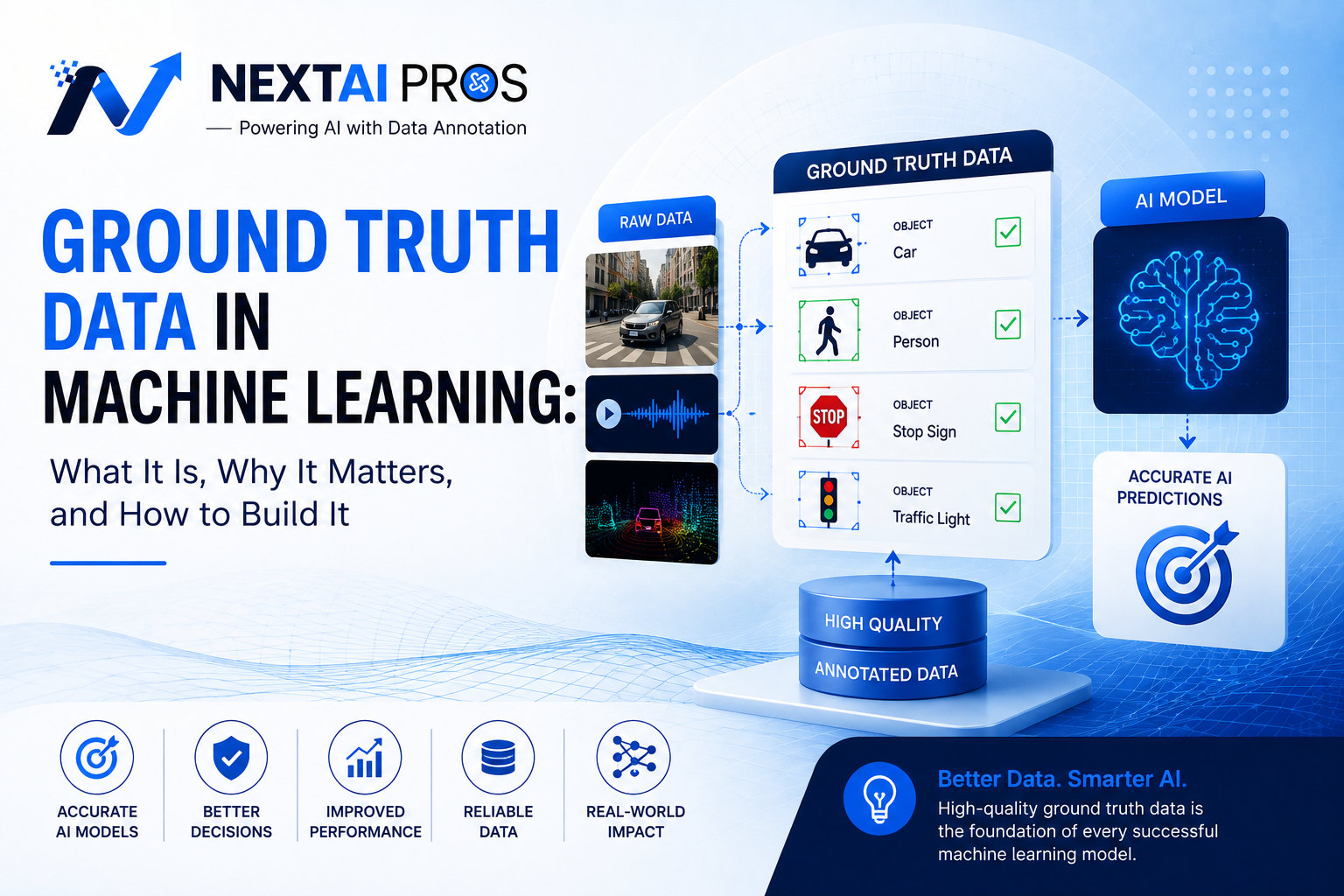
For example, imagine you’re developing an object detection system for autonomous vehicles.
The model sees an image and predicts:
Car — 92% confidence
But how do you know whether the prediction is actually correct?
A human-reviewed dataset might identify the object as:
Car — Ground Truth
Now the model’s prediction can be compared with the reference annotation.
The same idea can apply across many types of AI data:
- Images
- Video
- Audio
- Text
- Documents
- Speech
- Sensor data
- Multimodal datasets
The exact definition of “ground truth” depends on the problem you’re trying to solve.
Why Does Ground Truth Matter in AI?
An AI model can be extremely sophisticated, but its performance still depends heavily on the quality of the information used to train and evaluate it.
If the reference labels are inconsistent or incorrect, your evaluation can become misleading.
Imagine you’re testing a medical image model using a benchmark dataset where several conditions were labeled incorrectly.
The model may appear to perform poorly even when its predictions are reasonable.
Or the opposite can happen.
A flawed benchmark might make a weak model look better than it really is.
This is why ground truth is important throughout the machine learning lifecycle.
Ground truth can help teams:
- Evaluate model predictions
- Measure model performance
- Validate training data
- Test new model versions
- Identify annotation errors
- Compare different models
- Monitor performance over time
- Calibrate human annotators
- Investigate difficult edge cases
In other words, ground truth gives your team something reliable to measure against.
Ground Truth vs. Training Data: What’s the Difference?
These terms are often used interchangeably, but they don’t always mean the same thing.
Training data
Training data is the larger collection of examples used to teach a machine learning model.
For example, a computer vision model might be trained using millions of images containing:
- Cars
- Trucks
- Pedestrians
- Bicycles
- Traffic signs
The dataset needs to be large and diverse enough for the model to learn useful patterns.
Ground truth data
Ground truth is generally treated with a much higher level of scrutiny because it is used as a trusted reference.
It may be a smaller subset of the overall dataset, but the labels need to be carefully reviewed and consistently defined.
For example:
Training dataset:
1,000,000 labeled images
Ground truth benchmark:
A carefully selected and reviewed set of images used to evaluate the model.
The exact size and methodology depend on the project.
There isn’t a universal percentage that every AI team should use. The important question is whether the benchmark is representative, well-defined, and trustworthy enough for the decisions you’re making with it.
How Is Ground Truth Data Created?
Creating reliable ground truth starts long before an annotator opens an annotation tool.
A good process usually includes several important stages.
1. Start With a Clear Definition of “Correct”
Before collecting labels, define what the labels actually mean.
This sounds obvious, but it is one of the most important parts of an annotation project.
Suppose you’re labeling vehicles.
What should happen when:
- A vehicle is partially hidden?
- Only part of the vehicle is visible?
- Two vehicles overlap?
- The image is blurry?
- The object is too small to identify?
- A vehicle is visible only in the background?
If your guidelines don’t answer these questions, two experienced annotators can make completely different decisions.
Your annotation guidelines should explain:
- Label definitions
- Annotation methods
- Inclusion and exclusion rules
- Edge cases
- Ambiguous examples
- Quality requirements
- Expected output format
Good ground truth starts with good instructions.
2. Choose Data That Represents the Real Problem
A benchmark should not contain only the easiest examples.
If your production environment contains difficult images, noisy audio, unusual accents, poor lighting, or complicated conversations, your ground truth should account for those conditions.
For example, a speech recognition system might work well with:
Clear audio + one speaker + quiet environment
But production recordings may look very different:
Multiple speakers + background noise + accents + interruptions
If your benchmark contains only perfect recordings, it may give you a false sense of confidence.
A useful ground truth dataset should reflect the conditions your AI system will actually encounter.
That means considering:
Common examples
The situations your model will see frequently.
Difficult examples
Data that is harder to classify or annotate.
Edge cases
Rare situations that can expose weaknesses in your model.
Real-world variation
Different environments, speakers, devices, lighting conditions, languages, demographics, or other factors relevant to the application.
3. Put the Right People Behind the Labels
Not every annotation task requires a subject matter expert.
But some do.
Consider a simple image classification project where the goal is to distinguish cats from dogs.
A trained general annotator may be perfectly capable of doing that.
Now consider a dataset involving:
- Medical images
- Legal documents
- Financial records
- Specialized engineering drawings
- Complex scientific data
The required expertise changes.
For specialized projects, the people reviewing or creating the benchmark may need relevant domain knowledge.
At NextAI Pros, we believe the annotation workflow should match the complexity of the data, rather than assuming every project can be handled using the same process.
4. Use Multiple Reviews When Accuracy Matters
Even experienced annotators can disagree.
That doesn’t necessarily mean someone is careless.
Sometimes the data itself is ambiguous.
Consider an audio recording containing two people speaking at the same time.
Should the segment receive one speaker label?
Two speaker labels?
An “overlap” label?
There may be a legitimate reason for different annotators to interpret the segment differently.
For high-value ground truth datasets, teams can have multiple people independently review selected samples and then resolve disagreements through an adjudication process.
A simplified workflow might look like:
Annotator A
↓
Annotator B
↓
Compare Results
↓
Investigate Disagreement
↓
Expert Review
↓
Final Reference Label
This helps reduce individual mistakes and makes difficult decisions explicit rather than hiding them inside the dataset.
5. Review the Benchmark Before Using It
Creating the labels isn’t the end of the process.
The completed dataset should be reviewed for issues such as:
- Inconsistent labels
- Missing annotations
- Incorrect classifications
- Duplicate records
- Poor-quality source data
- Ambiguous instructions
- Formatting problems
- Unexpected edge cases
It can also be useful to test the benchmark against your existing annotation workflow.
If multiple annotators repeatedly disagree about the same examples, that may indicate a problem with the guidelines, not necessarily the annotators.
That’s an important distinction.
Sometimes the solution isn’t:
“Train the annotator better.”
It is:
“Our instructions aren’t clear enough.”
What Makes Ground Truth Data High Quality?
There is no single checkbox that makes a dataset “high quality.”
Instead, several factors work together.
Clear guidelines
Everyone involved should understand how labels are defined.
Consistent annotation
Similar examples should receive similar labels.
Representative data
The benchmark should reflect the situations the model will encounter.
Appropriate expertise
Complex domains may require specialized reviewers.
Quality control
There should be a process for finding and correcting mistakes.
Documented decisions
Important edge cases and disagreements should be recorded rather than handled differently every time.
Regular review
A benchmark should not necessarily remain unchanged forever.
As the product, data, or environment changes, the evaluation set may need to change as well
Can Ground Truth Ever Be Completely “True”?
This is where things get interesting.
The term ground truth can make it sound as though there is always one objectively correct answer.
Real-world data isn’t always that simple.
Consider sentiment.
A customer says:
“That’s just fantastic. Exactly what I needed.”
Depending on the context and tone, that sentence could be sincere or sarcastic.
Or consider an image where an object is almost completely hidden.
Or an audio recording where two people speak simultaneously.
Different qualified people may reasonably disagree.
Recent research has also highlighted the limitations of treating human disagreement as nothing more than annotation “noise.” In some tasks, disagreement can contain useful information about ambiguity, subjectivity, or differences in interpretation.
That means a strong annotation strategy shouldn’t simply try to force every difficult example into an artificial single answer.
Instead, teams should identify:
Where is there genuine uncertainty?
Why do annotators disagree?
Does the model need one label or multiple acceptable interpretations?
For some applications, documenting disagreement can actually make the dataset more useful.
Ground Truth for Different Types of AI Data
Ground truth isn’t limited to computer vision.
The process changes depending on the type of data.
Image Ground Truth
Examples include:
- Bounding boxes
- Segmentation masks
- Polygons
- Classification labels
- Keypoints
- Object attributes
For example, an autonomous driving dataset may require precise labels for vehicles, pedestrians, road signs, and road boundaries.
Video Ground Truth
Video introduces another dimension: time.
Annotations may need to track objects or events across multiple frames.
Examples include:
- Object tracking
- Action recognition
- Event detection
- Temporal segmentation
- Human activity
- Vehicle movement
A label that is correct in one frame may not be sufficient for understanding what happens throughout a video.
Audio Ground Truth
Audio datasets can contain much more information than a simple transcript.
Depending on the application, annotations might include:
- Speech transcription
- Speaker identification
- Speaker diarization
- Timestamps
- Intent
- Emotion
- Sentiment
- Sound events
- Language
- Accent or dialect
- Background noise
This type of ground truth can support speech recognition, conversational AI, voice assistants, call analytics, and other audio-based systems.
Text Ground Truth
Text datasets can be labeled for:
- Sentiment
- Intent
- Named entities
- Topics
- Toxicity
- Classification
- Question-answer pairs
- Summarization quality
- Search relevance
For large language model and NLP projects, the definition of “correct” can become particularly complex because multiple responses may be reasonable.
How Ground Truth Helps Evaluate AI Models
Once a reliable benchmark exists, you can use it to compare model predictions against known reference labels.
For example:
Ground Truth
Dog
Model Prediction
Dog
The prediction matches.
But imagine you test 10,000 examples and discover that the model consistently struggles with:
- Low-light images
- Certain accents
- Overlapping speech
- Rare vehicle types
- Specific document layouts
That information is valuable.
It tells your team where the model needs improvement.
Ground truth therefore isn’t just a dataset you create once and forget.
It can become an ongoing measurement system for the quality of your AI.
Ground Truth and AI Model Monitoring
AI systems operate in changing environments.
The data your model sees six months from now may not look exactly like the data used during development.
New devices appear.
Customer behavior changes.
Languages and terminology evolve.
New environments introduce new edge cases.
This can create data drift or changes in the patterns your model encounters.
A useful ground truth benchmark can help your team periodically test whether model performance is still meeting expectations.
That can lead to a continuous cycle:
Collect → Annotate → Evaluate → Improve → Re-evaluate
Instead of treating data quality as a one-time project, you make it part of the AI development lifecycle.
How NextAI Pros Helps Build Reliable AI Training Data
Creating a trustworthy dataset takes more than putting people in front of an annotation tool.
At NextAI Pros, we help AI teams turn raw data into structured, usable datasets through human-led annotation and quality-focused workflows.
Depending on the project, our services can include:
Image Annotation
Bounding boxes, polygons, segmentation, classification, keypoints, and other computer vision annotations.
Video Annotation
Object tracking, action recognition, event labeling, temporal annotation, and frame-level workflows.
Audio Annotation
Speech transcription, speaker diarization, timestamps, emotion, intent, and sound-event labeling.
Text Annotation
Entity labeling, sentiment, intent, classification, NLP annotation, and other language-data workflows.
Data Quality & Review
Annotation review, guideline validation, quality checks, and workflows designed around your project’s requirements.
We don’t believe every dataset should be handled exactly the same way.
Your model, data, annotation schema, and quality requirements should determine the workflow.
Final Thoughts
Building AI isn’t only about choosing the right model or increasing compute.
It starts with understanding the data.
Reliable ground truth gives AI teams a practical reference point for training, testing, and improving machine learning systems. But creating it requires thoughtful guidelines, representative data, appropriate expertise, and a quality process capable of dealing with ambiguity.
And sometimes, the most useful outcome isn’t discovering one “perfect” label.
It’s understanding why the data is difficult in the first place.
That is what turns annotation from a simple labeling exercise into a meaningful part of AI development.