
Image Annotation for Autonomous Vehicles: How Self-Driving Cars Learn to Read the Road
Taking a drive on Loop 101 in Phoenix on an open and bright day can be relatively easy for human beings. Smooth roads, bright weather conditions, and no obstructions in line of vision. But when it comes to self-driving cars, the job is not so easy. The self-driving car can only see in terms of pixels, but there is no way to make the car learn which pixels belong to a person and which to the shadows. Here comes the importance of image annotation.
Sept 13 2026
Image Annotation
Key Takeaways
- It is about annotating road data in order for the model to understand what these objects mean as opposed to their appearances
- Boxes, polygons, segmentation, and keypoints all address different labeling problems
- The weather and roads in a city make for a totally new labeling task compared to another city
- Humans will spot errors that the automated pre-labeling tools would miss
- In most cases, a well-labeled small set is always better than a large unorganized set
- Image annotation is simply one part. L2 to L4 level autonomous driving systems use sensor fusion and LiDAR alongside image annotations
What a Camera Record vs. What a Car Needs to Understand
A camera records light hitting a sensor. That’s it. It has no concept of a crosswalk, and it definitely doesn’t know why a cyclist wobbling near the curb might be about to swerve. Annotation is what closes that gap, and it’s what makes object detection possible in the first place, a model can’t find a pedestrian in a new frame unless it’s seen thousands of correctly labeled pedestrians before.
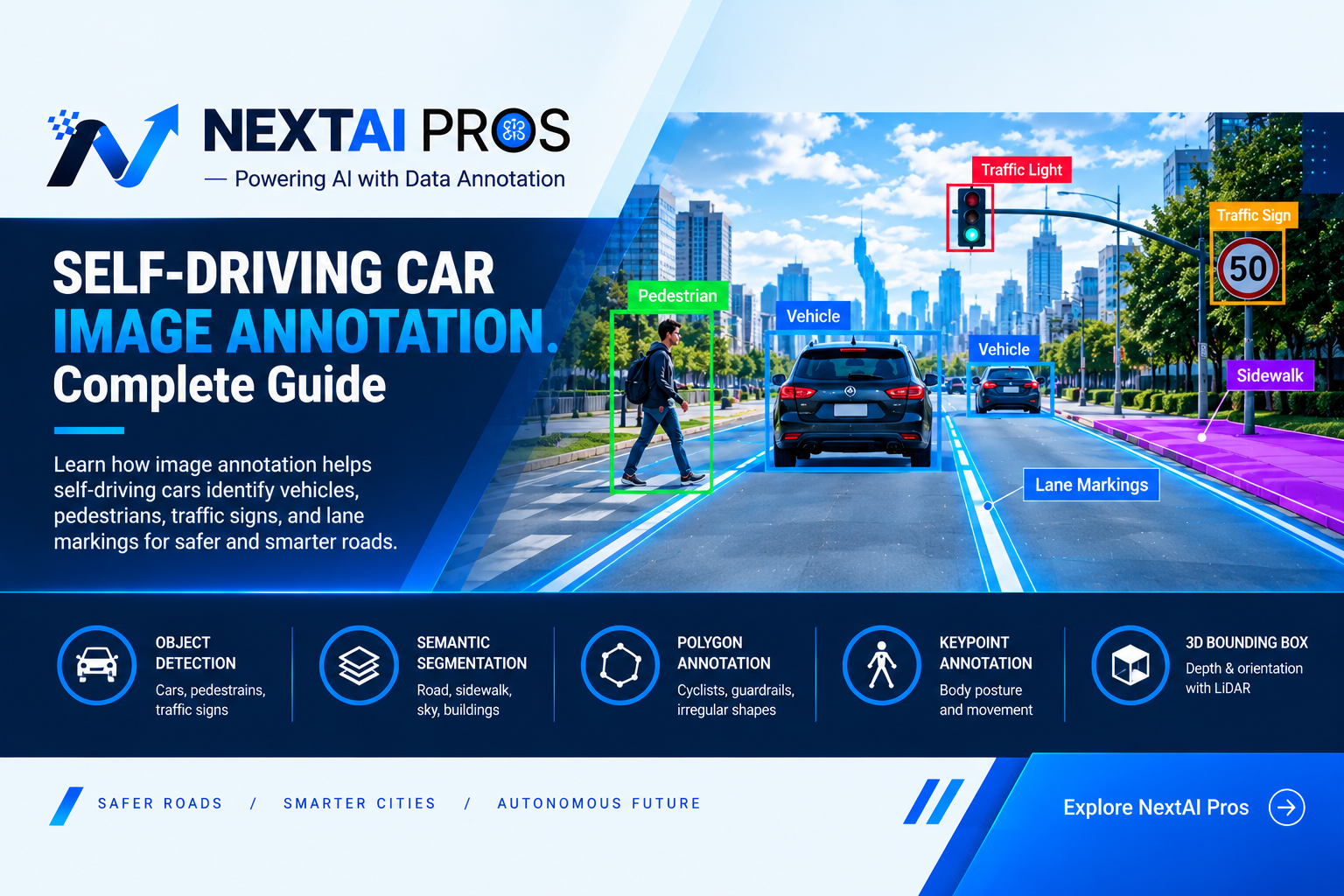
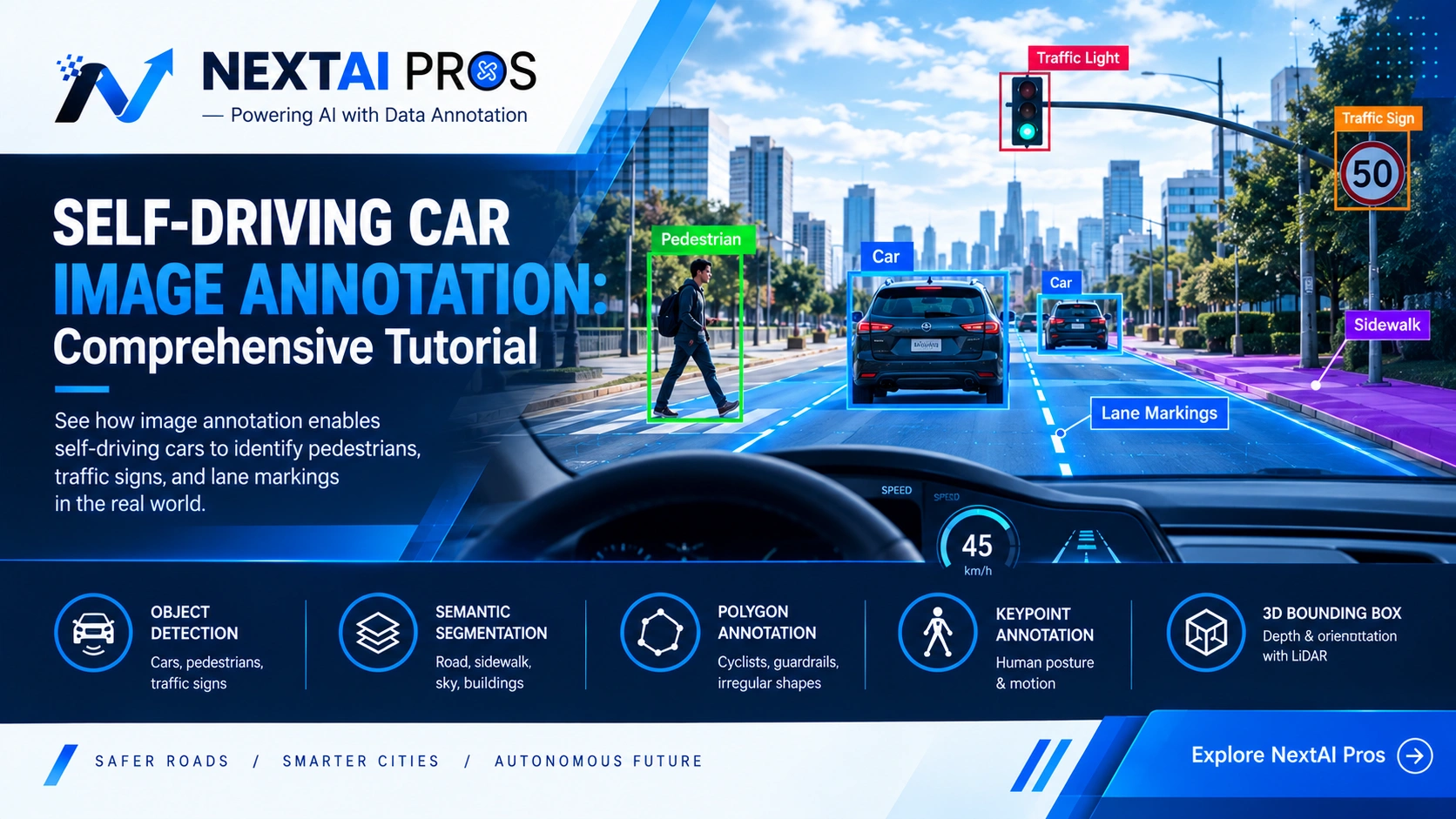
Imagine a single frame captured from a camera mounted on the front of a car at a busy intersection. In its original state, it has no purpose and is simply an image. After labeling, each car is surrounded by a bounding box, the sidewalk is labeled as a different entity from the road, and the traffic lights have a tiny marking placed directly over their centers. By repeating this process for tens of thousands of frames, a model begins to learn patterns automatically in the exact way a person comes to automatically recognize traffic signs without having to consciously think about them. That is when the importance of scene understanding becomes evident, as a model must not only be able to detect objects but also understand their relationship to one another within a scene.
Why a Missed Label Causes More Trouble Than It Looks
A skipped or wrong label doesn’t just sit quietly in a dataset doing nothing. It teaches the model something incorrect, and that mistake tends to show up again in every scene that looks similar. Miss one pedestrian in training and you risk the model misreading a real pedestrian later, on an actual street, at an actual crossing.
Autonomous vehicle data annotation ends up covering situations most people never think twice about. A pedestrian stepping off a curb before the light changes. A traffic signal washed out by afternoon sun glare on the windshield. A cyclist squeezed into a lane that’s honestly too narrow for two. A construction cone dropped somewhere it normally wouldn’t be. Lane paint that’s faded down to almost nothing on an older road. A parked car sitting still versus one that’s just about to pull out into traffic. Road hazards matter just as much, potholes, downed branches, debris in the lane, and temporary barriers around a work zone all need their own careful labels, since a model that’s never seen one won’t know to slow down for it.
None of that sounds dramatic. It’s ordinary street behavior, which is exactly why a model needs thousands of examples of it before it can be trusted.
How Footage Actually Becomes Training Data
The process sounds simple written down, though it takes real discipline to do properly.
The team starts by deciding what the model actually needs to detect, pedestrians, lane markings, road signs, whatever matters for that project. From there comes the guideline stage, writing rules down so two annotators working separately would still label the same object the same way. Annotators then work through the footage frame by frame using tools like CVAT, Roboflow, or Label Studio, applying boxes, polygons, or segmentation masks depending on what fits. A second person reviews the work against those guidelines and against the established ground truth before it ships anywhere. Only after that does the finished dataset actually reach the machine learning team.
Note: Most inconsistency in a large dataset traces back to one thing, someone rushed the guideline stage. Spending real time on it upfront saves far more hours than fixing mislabeled batches after the fact.
The Techniques Behind Autonomous Driving Image Annotation
Various items require different types of labeling. It is simply impossible to place both a parked car and a curved guardrail in the same shape.
The bounding box is the fastest way of doing things, which means drawing a rectangle around a specific item, such as a car or a pedestrian. This works well when speed is prioritized over accuracy in pixels.
Semantic segmentation involves coloring all the pixels depending on their category so that the model sees the road as one surface, rather than a number of individual items.
The polygon annotation allows drawing a shape that cannot be accurately described using the rectangle, for instance, a cyclist who makes a turn, and a guardrail that is curved following the landscape of the hillside. The keypoint annotation highlights certain points on the body or object, including shoulders of a pedestrian and wheels of a car.
Segmentation divides the items of the same type into distinct units; therefore, if there are ten people at the bus station, then each person will be highlighted separately rather than blending into one outline.
3D cuboid annotation goes beyond 2D rectangle and creates a three-dimensional shape that gives the object depth and orientation in contrast to 2D annotation. It becomes especially significant when using image data in combination with LiDAR, as 3D annotation provides information about the distance from the object to the camera and its orientation.
Technique | Best For | Example |
Bounding Box | Fast object detection | Cars, signs |
Semantic Segmentation | Full scene understanding | Road, sidewalk, sky |
Polygon | Irregular shapes | Cyclists, guardrails |
Keypoint | Motion and posture | Pedestrian joints |
Instance Segmentation | Telling similar objects apart | A crowd of people |
3D Bounding Box | Depth and orientation | Vehicles paired with LiDAR |
Where Image Annotation Fits Into the Bigger Autonomy Stack
Image annotation is one piece of a much bigger puzzle, and it helps to know where that piece sits. Autonomy is usually described in levels, from L2 systems, the kind found in most modern ADAS-equipped cars that still need a driver watching the road, up through L4 systems that can handle most driving on their own within a defined area. The higher the level, the more the model depends on clean, varied labeled data across every kind of scene.
Cameras rarely work alone at higher autonomy levels. Most L3 and L4 systems rely on sensor fusion, blending 2D image annotation with LiDAR point clouds and radar data so the car understands not just what an object is, but exactly how far away it sits and how fast it’s moving. When LiDAR scans are annotated across several frames in sequence, teams sometimes call this 4D point cloud labeling, since time becomes a fourth dimension alongside the usual three.
Newer projects are also starting to use VLA annotation, short for vision-language-action labeling, which pairs an image with a short text description and the action a car should take in response. It’s a newer technique, mostly tied to foundation models being trained for driving, and it demands annotators who understand both computer vision and natural driving behavior.
In-cabin monitoring is another area growing alongside this. Cameras facing the driver, not the road, use annotated footage to detect drowsiness or distraction, which matters just as much for L2 and L3 ADAS systems that still expect a human to take back control. Our video annotation team handles this kind of frame-by-frame temporal labeling, tracking drowsy blinking or head position changes across a clip rather than a single still image.
Why One City’s Footage Never Teaches a Model Everything
Phoenix is a decent place to start training a model. Flat roads, wide open sightlines, sun most of the year, especially along stretches like Loop 101. But a model trained only on Phoenix footage runs into trouble the first time it meets actual fog rolling in off the bay near San Francisco’s Market Street, where steep hills and tighter traffic demand a lot more careful labeling than a desert highway ever would.
Austin brings its own mess into the picture, with pedestrians, cyclists, and cars all crowding the same narrow stretch near South Congress Avenue during rush hour. Head further north and cities like Pittsburgh, with its bridges and tunnels, throw snow and reduced visibility into the equation, conditions a desert city simply never produces.
This is really why testing spreads across so many regions in the first place. Autonomous vehicle image annotation services that draw from a mix of climates and street layouts end up training models that hold up somewhere other than their home turf.
Where a Person Still Beats the Algorithm
Automated labeling tools have gotten noticeably better over the past couple years. They still miss things a trained annotator catches right away though, a stop sign half swallowed by shadow, or a pedestrian barely visible behind a parked delivery truck.
Some calls just need a person making them. Whether a partly hidden pedestrian is actually a safety risk or not. How to label a construction zone that doesn’t follow any standard layout. Catching an object an automated tool got wrong entirely. Making sure labels stay consistent against the ground truth across a dataset with thousands of nearly identical frames, which is a lot easier to say than to actually do well.
The Ordinary Problems Annotation Teams Deal With
A handful of issues come up over and over, and none of them are especially exotic.
Weather changes how everything in a frame looks, so guidelines have to treat rain, glare, and snow as separate cases rather than assuming one label style covers all of them. Occlusion is a constant annoyance too, since a pedestrian half hidden behind a parked car still needs an accurate label even with most of their body out of view.
Scale trips people up as well. A car sitting right in front of the camera looks completely different from that same car two hundred feet down the road, yet both need the same level of care. And after hours spent reviewing nearly identical highway frames, attention starts to slip, which is exactly why quality checks need to happen throughout the process and not just at the very end.
Beyond Passenger Cars
Self driving car image annotation doesn’t stop at robotaxis. Sidewalk delivery robots use the same kind of labeled footage to avoid pedestrians and parked cars on their routes, work that overlaps closely with what our logistics industry clients need for route and obstacle detection. Autonomous construction equipment relies on it to keep clear of workers on active sites. Self-driving tractors need labeled field imagery just to stay inside their planting rows. Security patrol vehicles with autonomous features lean on similar labeled data too, which ties closely into the work we do for security and surveillance clients tracking people and vehicles across a monitored area.
The industry changes. The underlying need for accurate, trustworthy data labeling really doesn’t.
More Frames Doesn’t Mean a Better Model
It’s tempting to assume a bigger dataset always wins, but that’s rarely how it actually plays out. Ten thousand nearly identical highway frames teach a model far less than five hundred varied ones covering rain, glare, and a genuinely crowded intersection. Training data for autonomous vehicles works better when it’s diverse and properly checked against a solid ground truth, not just piled up in bulk.
How NextAI Pros Approaches This Work
At NextAI Pros, image annotation for autonomous vehicles gets treated as a precision job, not a race to hit some frame count. Every batch our team labels goes through human review before it ever reaches a client, so mislabeled frames don’t quietly slip into a training set.
Our image annotation services cover road scenes across a range of conditions, from clear desert highways to foggy city corners, using industry-standard platforms like CVAT, Roboflow, and Label Studio to keep the workflow consistent from batch to batch. For projects pairing camera data with 3D point clouds, our LiDAR annotation team adds the depth layer a lot of automotive models still need, and our automotive industry page covers the full range of work we do across this space, from perception models to in-cabin monitoring.
Ready to build training data that actually holds up on the road?
Book a discovery call with our automotive annotation team and we’ll walk through your dataset needs, no pressure, no generic sales pitch.
Where This Is Headed
A camera by itself will never teach a car to drive safely. That work happens frame by frame, city by city, through labeling most people never think about. As testing keeps spreading into new regions and autonomy levels keep climbing, the need for accurate, varied training data isn’t going anywhere soon.
Frequently Asked Questions
What is image annotation for autonomous vehicles?
It’s the process of labeling road images and video so AI models can recognize cars, pedestrians, signs, and lane markings, turning raw footage into ground truth data a self-driving system can actually learn from.
Why does image annotation matter so much for self-driving cars?
Without labeled data, a model has nothing to reference for what objects on the road actually mean. Accurate labeling directly shapes how safely a self-driving car behaves in real traffic.
What annotation methods come up most in autonomous driving?
Bounding boxes, semantic segmentation, polygon annotation, keypoint labeling, and 3D bounding box annotation are the techniques used most often to train perception and object detection models for self-driving systems.
How is LiDAR annotation different from image annotation?
Image annotation labels 2D camera footage. LiDAR annotation labels 3D point cloud data instead. Many autonomous vehicle projects use both together, sometimes called sensor fusion, for stronger spatial accuracy.
What is VLA annotation?
VLA stands for vision-language-action annotation. It pairs an image with a text description and the driving action expected in response, used mainly to train newer foundation models for autonomous driving.
What's the difference between ADAS and full autonomy?
ADAS refers to driver assistance features, like lane-keep assist or automatic braking, found in L1 and L2 vehicles where a human still drives. Full autonomy (L4 and up) means the system handles driving itself within a defined area, and it depends on far more annotated data to get there safely.
Can automated tools fully replace human annotators at this point?
Not really, no. Automated tools speed up the first labeling pass, but human reviewers still catch errors in shadows, occlusion, and odd edge cases automated systems tend to miss.
Does more labeled data always mean a better model?
Not necessarily. Variety across weather, lighting, and traffic situations matters more than raw volume, along with strict quality checks at every stage of the process.
At NextAI Pros, our clients are not just customers — they’re valued partners in every project. We offer personalized support to help you navigate your AI data journey, from choosing the right annotation approach to understanding your project’s unique requirements. Whether it’s answering your queries or providing expert guidance on data strategy and implementation, NextAI Pros is with you every step of the way.
Categories
- Image Annotation
- Video Annotation
- Text Annotation
- Audio Annotation
- LiDAR Annotation